Climate stress tests of Investment Funds

Climate stress tests of Investment Funds
The Austrian Financial Market Authority (FMA) has conducted stress tests regarding the impact of future climate policy, the introduction of low-carbon technologies, the level of economic adaptation and the occurrence of extreme events in order to analyse the risks and vulnerabilities of the Austrian investment fund sector, especially regarding the current economic environment and for assessing the risk of individual funds and investment fund management companies (KAGs).
Under the current scenarios, shocks were assumed that were in line with the European Commission’s Fit for 55 package (Green Deal). The European Green Deal’s objective is for the European Union (EU) to achieve climate neutrality by 2050. The European Commission has accepted a range of proposals, to design the EU’s climate, energy, transport and fiscal policy in such a way that nett greenhouse gas emissions can be reduced by at least 55% compared to the levels for 1990 (Fit for 55 package).
The financial system’s resilience while implementing the Fit for 55 package was evaluated in a scenario analysis, and findings reached about the financial system’s ability to support the transition to a lower carbon economy even under stress conditions. The FMA has applied the accompanying European Systemic Risk Board (ESRB) stress test scenarios.
- The baseline scenario reflects a smooth, timely, and widely expected green transition, in which governments implement the political measures of the Fit for 55 package (reduction of emissions by 55% compared with 1990 values) as intended. In this way considerable reductions in fossil fuel emissions levels will be achieved, that are in line with the EU’s objectives for 2030 and the objectives of the Paris Agreement. These developments are occurring in an economic environment that correspond to the baseline scenario for the European Banking Authority (EBA)’s EU-wide stress test from 2023 (2023-2025) and the subsequent Nationally Determined Contributions (NDC) scenario of the Network for Greening the Financial System (NGFS) (2026-2030).
- The first adverse scenario contains a sudden negative revaluation of the transitional risks and is characterised by a sudden shock in confidence. The shock consists of a sudden reversal of the perception of climate-related risks, is not traced back to the transposition of the Fit for 55 package and is reflected by a sell-off of assets designated as “brown”. The shock, which represents a flight from brown assets to non-brown assets, manifests itself in the form of higher financing costs for brown companies, and applies for the period between 2026-2030.
- The second adverse scenario takes into account an intensification of climate-related shocks considered in the first adverse scenario, and the globally deteriorating macroeconomic conditions, in line with the adverse scenario of the EU-wide EBA stress test and applies to the years 2023-2025. The intensified stress factors combined with the flight from brown assets, which applies for 2026-2030, require far-reaching government interventions for promoting the green transition, which leads to a surge in public sector borrowing and leads to concerns being raised about debt sustainability.
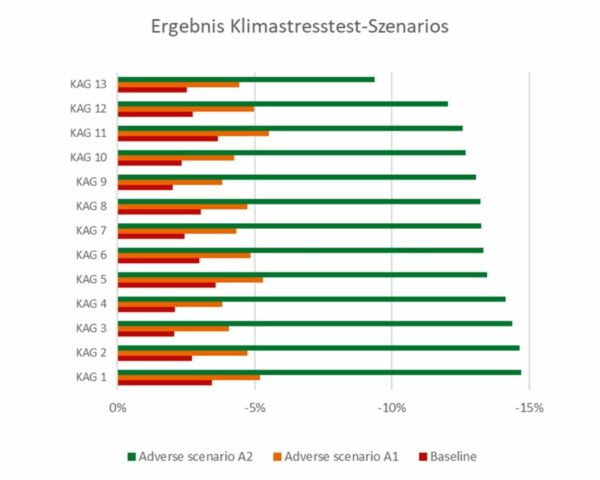
The stress tests conducted by the FMA in 2025 (data cut-off date 31.12.2024) indicate manageable and acceptable losses in value for Austrian funds if the EU climate policy (baseline scenario of the Fit for 55 package) is implemented. Associated risk exposure to such transition risks varies depending on the investment fund management company, but is a range that is essentially determined by the respective asset allocation. In summary, implementation of EU climate policy does not pose any systemic risks for the Austrian fund market, although certain exposures exist to transition risks and it therefore appears essential for such risks to be addressed in investment fund management companies’ risk management.