National Stress Tests

National Stress Tests – Corporate Provision Companies
The Austrian Financial Market Authority (FMA) regularly conducts stress tests to analyse the risks and vulnerabilities of the corporate provision company sector especially with regard to the current economic climate as well as for assessing the risk capacity of the individual corporate provision companies. The impact of various market events are tested and liability-side shocks simulated for this purpose.
Instruments for analysing the Risks and Vulnerability of the Corporate Provision Companies Sector:
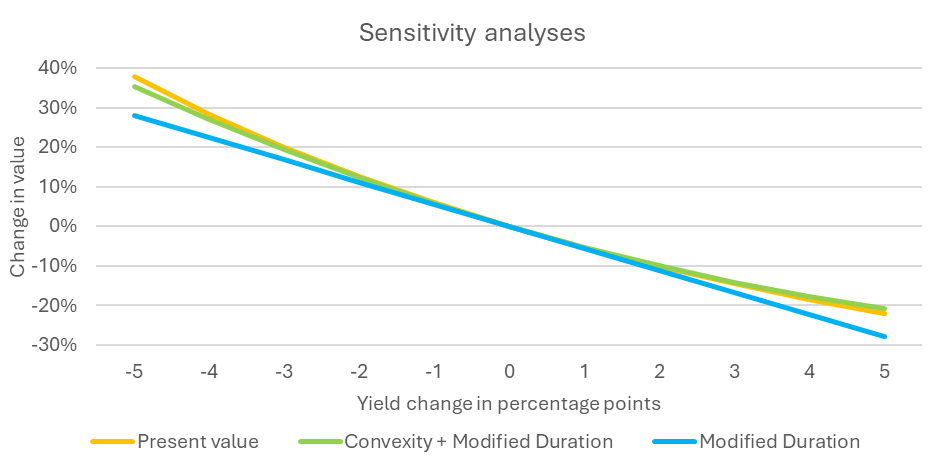
- Sensitivity analyses (usually) relate to a single risk factor and measure the potential reaction of a performance or risk indicator depending on how it changes. This is based on standardised changes in risk factors, the magnitude of which is not necessarily required to relate to economic conditions (in terms of being probable, improbable, historical, etc.)
In this way, the FMA regularly analyses the sensitivities of corporate provision companies’ bond portfolios on the asset side of the balance sheet. The accompanying calculations are conducted using an individual cash flow breakdown, including recalculating the present value as well as by using approximations. The latter is conducted on the basis of the modified duration – both with and without convexity.
- Scenario analyses as a rule are based on changes in (one or more) risk factors that follow an economic narrative, i.e. where their magnitude is estimated with regard to probability or plausibility.
- Stress tests are scenario analyses that are based on extreme yet nonetheless plausible changes (shocks) in risk factors.
- In the case of Reverse Stress Tests the change is selected in such a way that the indicators in question achieve a certain target value.